Free · Excel workbook
The exit interview kit.
Twenty questions that get a usable answer, a tracker that codes them so twenty exits become a pattern, and a rollup that measures the two numbers no published benchmark can give you.
Most exit interviews are theatre. The person has already gone, has nothing to gain from precision, and is talking to the organisation they just left. This kit is built around the one thing an exit interview does establish well (timing), and around making the answers countable rather than quotable.
Just want the questions? Read the full question bank on the page. No email, nothing to download.
Six sheets, and nothing to set up.
Question bank
Twenty questions grouped by what each is actually testing, with a useless answer and a usable one side by side, plus the follow-up probe that gets you from one to the other.
Response tracker
One row per leaver, with the coded columns on dropdowns so twenty exits become a pattern instead of twenty anecdotes.
Rollup
Reads the tracker and gives you the quarter: preventability, who had no conversation about their future, and the breakdown by reason.
Stay interview
The same questions, six months earlier, for people who have not resigned. The only sheet here that can still change an outcome.
Sources and cautions
Short, because very little in this field is established. Names each figure you will meet and says plainly which ones are vendor claims with no method.
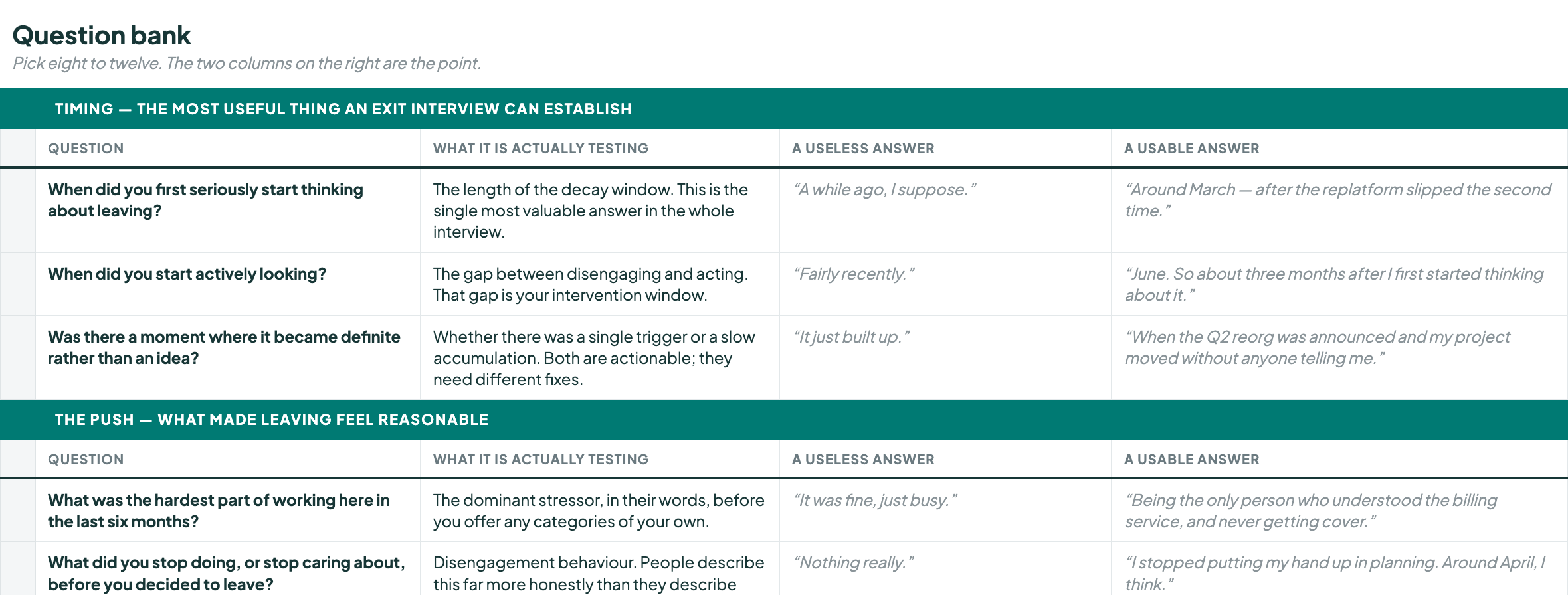
The question bank, as it opens.
It measures what the cost model refuses to guess.
Our cost of burnout attrition model supplies a default for almost every input it uses. It refuses for exactly two, because no credible India benchmark exists for either: the share of voluntary exits that are burnout-driven, and how many months the decay ran before the resignation.
Those two move the final number more than anything else, and the only honest way to get them is to measure your own exits. The Rollup sheet computes both, formatted to drop straight into the calculator. That is the whole reason this kit exists.
Read them together with the third figure on that sheet, the proportion who say nobody discussed their future in their final three months. If the decay ran four months and half of them had no such conversation, then the information existed for four months and nobody went looking for it.
Read next
- Exit interview questions that get you a usable answerThe full question bank on the page, with what each question is testing and how to code the answers.
- The signs someone is about to quitWhat shows up before a resignation, and the stay-interview questions that get an honest answer.
- The cost of finding out too lateWhat an avoidable exit costs, built from the bottom up. The model these two numbers feed.